

The Battle of the Bulls and Bears Enters Q4
It’s been a long time since we’ve seen such a battle between bulls and bears. Chris comments frequently that he’s never experienced such pessimism among shareholders while the major stock indexes are doing so well. Here’s a sample of year-to-date returns for several of the major U.S. stock market indexes and market sectors.
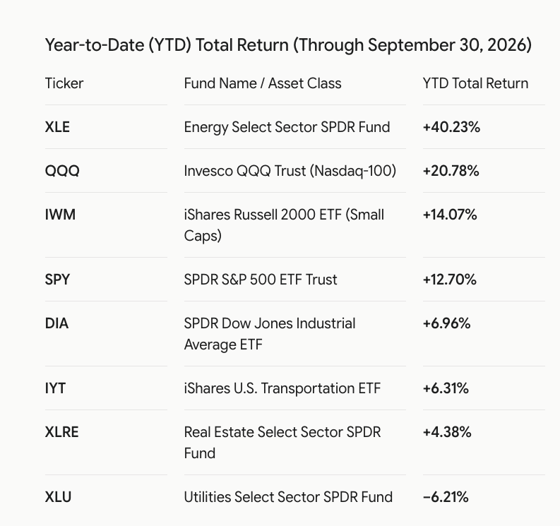
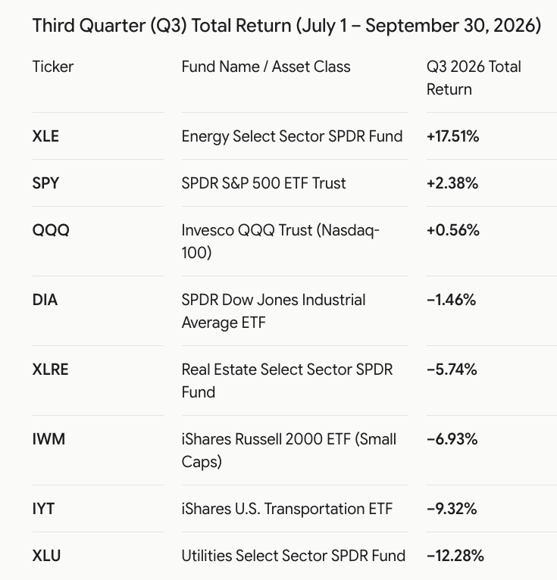
The Nasdaq 100 and the S&P 500 are up double digits for the year, and for the third year in a row. The Energy Select Sector SPDR Fund (XLE) leads the way, up over 40%, and that’s one of the sources of worry for both shareholders and consumers. The XLE is up because oil and gas prices are way up, a consequence of the war with Iran. We need this ETF, and oil and gas prices, to recede in Q4 to fuel the rise of other indexes and major sectors. While markets are up for 2026, Q3 was pretty much flat to down. That’s added to shareholder anxiety, and begs the question “what will Q4 bring?
Both Chris and I read enough conflicting forecasts to make our heads spin. We’ve certainly noticed the bears getting louder about their pessimistic perspective. The bulls are in a bit of a retreat. They remain bullish, but many have reduced their forecasts for Q4 gains. I’ve mentioned Ed Yardeni in my last few newsletters. He’s consistently forecast a year-end value of 8400 for the S&P 500 but brought it down to 7900 just a few weeks ago. On the other hand, Tom Lee, of Fundstrat, recently raised his year-end target from 8000 to 8200. He expects a “robust end-of-year market run, a face-ripping rally. Core drivers of the rally will be ongoing AI momentum, leadership from major tech, the Magnificent Seven, and better than expected corporate earnings”. (Source: CNBC.com) We remain in the bullish camp. We don’t state specific price targets, but we feel strongly that corporate earnings can support a Q4 rally. It would sure help if the war ended, oil and gas supplies trend back toward normal, and prices drop!
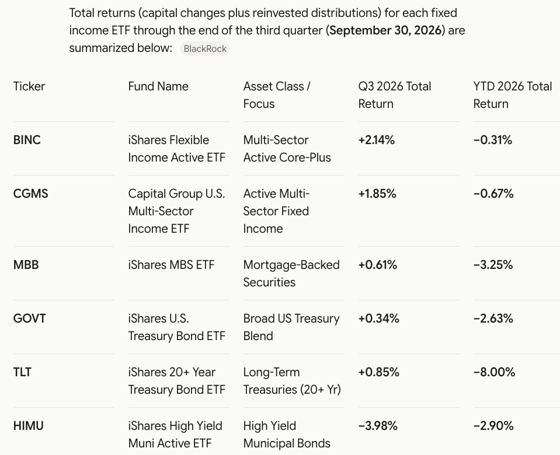
Rising interest rates are also challenging stock prices, while depressing bond prices. Here’s a list of six ETF’s that are invested in bonds. Note that all of them are down year-to-date. Interestingly five of them were up in Q3. If we see any significant decline in rates during Q4 these will all rise in value. If rates continue to rise in Q4 they will likely all continue to decline in price. The markets would welcome stable or declining rates.
Every week we see data on “official inflation”, and it’s very misleading in my opinion. I’ve written about this before. Year to date we’ve seen several important commodity prices rocket upward, much more than “official inflation. We have small allocations to commodities in most of our strategies. They have acted as ballast against the drop in bond prices.
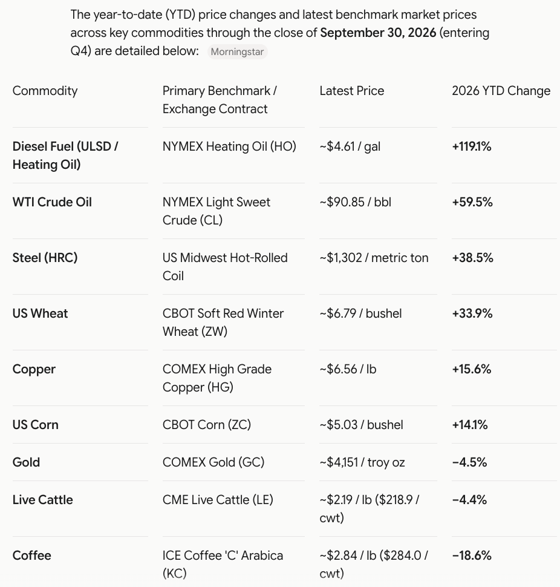
While most of these prices are up from 14% to 119% the “U.S. personal consumption expenditures inflation index”, the Fed’s preferred measure, came in at 3% annualized rate for August, excluding food and energy. Why they exclude food and energy, which we all need and purchase, I will never understand…except maybe for “smoke and mirrors”.
Anyway, I’m drafting this the morning of October 1, 2026. Q4 is officially underway, and the S&P 500, Nasdaq 100, and Dow Jones Industrial Average are down (at least for the moment). Bond prices are up (at least for the moment). We don’t know if there will be a “face-ripping rally”, Tom Lee style, but we remain in the bullish camp for the remainder of the year for reasons he states. We see an economy that is continuing to march steadily forward, so we don’t see any reason for people to pull back meaningfully on risk. We will continue to adjust our equity exposure to reduce dependence on AI while we continue to be cautiously optimistic about equities across all of our strategies. If the war drags on, if rates rise significantly from here, if the Houthis launch new offenses, we may have to change our perspective. If we do, we will tell you.
For the record, November consistently ranks as the highest average return month for stocks. December ranks 3rd among months for highest average return. They rank #1 and #2 for consistency of positive returns. Year-end strength is historically most pronounced when the market is already trending positively entering Q4, which it is this year. This is not a guarantee of positive returns, but it’s a hopeful indicator.
Several seasonal and structural factors often contribute to the late-year strength:
Institutional Window Dressing & Performance Chasing: Fund managers who are trailing their benchmarks often deploy excess cash into winning stocks toward the end of the year to bolster reported performance.
Post-Election Clarity: In election years, political uncertainty typically resolves in early November, often triggering relief rallies into year-end.
The "Santa Claus Rally": Historically, trading days between Christmas and the first two days of the New Year experience lighter trading volume, lower tax-loss selling pressure, and positive retail inflows.
Corporate Buyback Resumption: Companies often lift buyback blackouts in November following Q3 earnings releases.
All the best,

Paul Krsek
CEO
5T Wealth, LLC
Main (707) 224-1340
Cell (707) 486-7333
Paul@5twealth.com

Disclosure and Disclaimer - Updated last on October 14, 2025:
CEO's Corner is a proprietary newsletter written for clients, friends, and affiliates of 5T WEALTH, LLC (5T), which is an SEC registered investment advisor. Information presented is for educational purposes only. The information does not intend to make an offer or solicitation for the sale or purchase of any specific securities, investments, or investment strategies. Investments involve risk and are not guaranteed. 5T has reasonable belief that this letter does not include any false or material misleading statements or omissions of facts regarding services or investments. 5T has reasonable belief that the content as a whole will not cause an untrue or misleading implication regarding the adviser’s services, investments, or client experiences.
The opinions expressed are those of the author and are subject to change without notice. The opinions referenced are as of the date of publication and are subject to change due to changes in the market or economic conditions and may not necessarily come to pass. Any opinions, projections, or forward-looking statements expressed herein are solely those of the author. They may differ from the views or opinions expressed by other areas of 5T and are only for general informational purposes as of the date indicated.
5T has presented information in a fair and balanced manner. 5T is not giving tax, legal, or accounting advice.
Past performance should not be considered an indicator of potential future performance. If you do not consider yourself suitable, either emotionally or financially, to experience volatility and/or losses in financial markets, you should not invest. The portfolio managers at 5T do not guarantee investment results.
Charts, displays and graphs may be used as illustrations. They are not intended to be used by themselves to determine which securities to buy or sell, or when to buy or sell them. Such charts and graphs offer limited information and can’t be used on their own to make investment decisions.
CEO Corner does not represent the opinions of Fidelity, Fidelity Institutional Brokerage Group, NFS or anyone employed by Fidelity in any capacity. Neither Fidelity, Fidelity Institutional Brokerage Group, nor NFS, nor anyone employed by Fidelity in any capacity has participated in the creation of CEO Corner and they are not responsible for the contents or distribution of CEO Corner.
CEO Corner does not represent the opinions of Charles Schwab Corporation, Schwab Advisor Services or anyone employed by Schwab in any capacity. Neither Charles Schwab Corporation nor Schwab Advisor Services, nor anyone employed by Schwab in any capacity has participated in the creation of CEO Corner and they are not responsible for the contents or distribution of CEO Corner.
The investment objectives of various strategies mentioned in CEO Corner may be substantially different from one another. Therefore topics or investments mentioned in CEO Corner may or may not apply to specific managed accounts and/or strategies. If you are unsure which strategies your accounts are invested in please ask a representative of 5T to clarify that for you.
The assets held in managed accounts at 5T may include stocks, bonds, cash, commodities, foreign exchange, mutual funds or exchange traded funds (ETF's), money market accounts or limited partnerships that represent the same. They are subject to market fluctuation and the potential for losses. The assets are not insured. The value and income produced by these investment products may fluctuate, so that an investor may get back less than they initially invested.