

The Hidden Gem of the OBBBA
When the One Big Beautiful Bill Act (OBBBA) was formally signed into law on July 4, 2025, most of the headlines focused on the extension of the original 2017 tax cuts, SALT cap updates, no tax on tips or overtime, and the senior deduction. Understandable as those are meaningful changes for many Americans. However, quietly tucked inside the legislation was something that could be even more impactful for those with significant capital gains: an overhaul of the Qualified Opportunity Zone (QOZ) program.
Here's what changed, why it matters, and how you might be able to take advantage of it.
First, a Quick Refresher
Qualified Opportunity Zones were created back in 2017 to encourage investment in lower-income and underdeveloped communities.
The incentive for investors was this:
· Invest your realized gain into a Qualified Opportunity Fund (QOF) within 180 days and defer taxation on the gain
· If held for 5-7 years, a portion of deferred gain would receive a permanent exclusion from taxation
· Receive a permanent exclusion of any appreciation gains inside the QOF after holding for 10 years or more
· The initial tax due on the realized gain rolled into the QOF would be deferred until the earlier of disposition of the investment or December 31, 2026, after considering the 5–7-year exclusion amounts.
Because of the looming expiration date of the original rules, it became a part of the larger OBBBA bill passed last summer.
What’s New Under the OBBBA?
The Program is Now Permanent
One of the most significant changes, the QOZ program no longer has a sunset. Previously, new investments made after 12/31/2026 no longer qualified for the QOZ tax benefits. Now the program lives on indefinitely, which gives both investors and fund managers more long-term clarity. With the 180-day investment period, this means that sales that take place today could be eligible for investment in a QOF on 1/1/2027.
Zones Will Be Refreshed Every 10 Years
Starting January 1, 2027, states can re-designate their Opportunity Zones every 10 years. Going forward, designations are more stringent, only areas with census data showing the median family income does not exceed 70% of the statewide median income (down from 80% in the 2017 rules). This is good news, it means that future zones will be genuinely distressed areas in need of improvement, with real upside potential.
A New 5-year Rolling Deferral Period
For Investments made on January 1, 2027, and later, the deferred gain will now be recognized on the 5th year anniversary of your investment date. You also receive a 10% step-up in basis, meaning only 90% of your original deferred gain (or investment) is taxable. After 10 years, any appreciation in the fund above your basis is completely tax-free.
Qualified Rural Opportunity Funds (QROF)
The QROF is designed to direct capital into, you guessed it, rural communities. If you opt to invest in a QROF over a QOF, the benefits are slightly different. The step-up in basis in year five is increased to 30% and there is a reduced capital improvement threshold from 100% in the regular QOF down to 50%.
How the Numbers Look in Practice
Let’s say you are selling some appreciated stock (note: this works for all types of capital gains, including real estate and businesses). You have a $1 million in this appreciated stock, $200k of which is basis and $800k is capital gain. You sell your stock and take your basis out – that $200k is yours to do whatever you want with – and reinvest the $800k into a QOF within 180 days.
- Original Tax Due $190,400 (Assuming 23.8% long term capital gains rate)
- After 5 years and 10% basis step up, taxes now are due on $720,000
• Tax Paid: $171,360, a $19,040 tax-savings
- Your total after tax take home from the original $1 million – not including any appreciation: $828,640
Here’s a quick comparison of no QOF or QROF, QOF, and QROF using the same initial details as above, and assuming a 7.2% yearly rate of return:
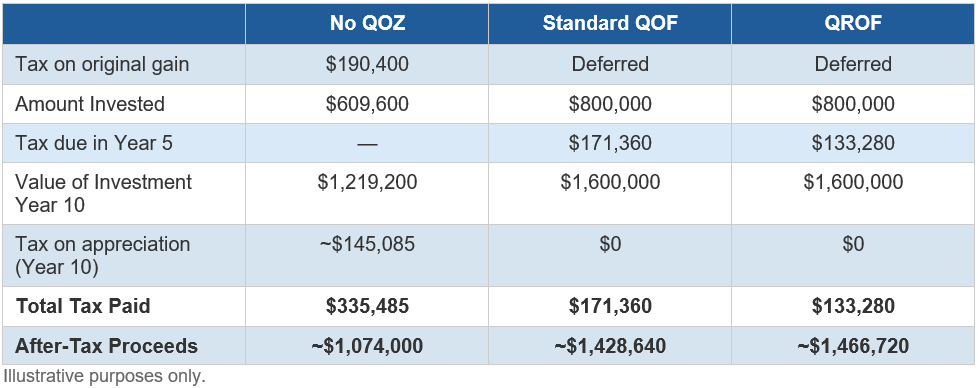
Pretty impactful tax savings from doing nothing to choosing a QOZ investment.
What About 1031 Exchanges?
While 1031 exchanges will still have their place, there is really one key advantage of a QOZ over a traditional 1031 when it comes to real estate. The QOZ requires you to reinvest only the gain instead of reinvesting the entire sale proceeds (including equity and matched debt) into a like-kind property. In the example above that means your $200k of equity would be free to deploy, and the $800k gain goes to work in a fund.
What Should You Know?
If you are, or are expecting, a significant capital gain from the sale of real estate, a business, or other investment, now is a great time to have a conversation about whether a QOF or QROF makes sense for your situation. A few things to keep in mind:
- You have 180 days from the date of the sale to reinvest the gain
- Not all funds are created equal, due diligence on the fund managers and underlying assets matters
- Rural QROFs offer better tax incentives, but may have a much more limited deal pipeline
- The program has been made permanent, so there’s no reason to rush into a bad deal
As always, the right approach or strategy depends on how all the pieces work together within a broader plan.
Sincerely,
Colton Maher
Financial Planner and Advisor
5T Wealth, LLC
Main (707) 224-1340
Cell (707)815-0843
Colton@5twealth.com
Disclosure and Disclaimer - Updated last on October 14, 2025:
Your Financial Roadmap is a proprietary newsletter written for clients, friends, and affiliates of 5T WEALTH, LLC (5T), which is an SEC registered investment advisor. Information presented is for educational purposes only. The information does not intend to make an offer or solicitation for the sale or purchase of any specific securities, investments, or investment strategies. Investments involve risk and are not guaranteed. 5T has reasonable belief that this letter does not include any false or material misleading statements or omissions of facts regarding services or investments. 5T has reasonable belief that the content as a whole will not cause an untrue or misleading implication regarding the adviser’s services, investments, or client experiences.
The opinions expressed are those of the author and are subject to change without notice. The opinions referenced are as of the date of publication and are subject to change due to changes in the market or economic conditions and may not necessarily come to pass. Any opinions, projections, or forward-looking statements expressed herein are solely those of the author. They may differ from the views or opinions expressed by other areas of 5T and are only for general informational purposes as of the date indicated.
5T has presented information in a fair and balanced manner. 5T is not giving tax, legal, or accounting advice.
Past performance should not be considered an indicator of potential future performance. If you do not consider yourself suitable, either emotionally or financially, to experience volatility and/or losses in financial markets, you should not invest. The portfolio managers at 5T do not guarantee investment results.
Charts, displays and graphs may be used as illustrations. They are not intended to be used by themselves to determine which securities to buy or sell, or when to buy or sell them. Such charts and graphs offer limited information and can’t be used on their own to make investment decisions.
Your Financial Roadmap does not represent the opinions of Fidelity, Fidelity Institutional Brokerage Group, NFS or anyone employed by Fidelity in any capacity. Neither Fidelity, Fidelity Institutional Brokerage Group, nor NFS, nor anyone employed by Fidelity in any capacity has participated in the creation of Your Financial Roadmap and they are not responsible for the contents or distribution of Your Financial Roadmap.
Your Financial Roadmap does not represent the opinions of Charles Schwab Corporation, Schwab Advisor Services or anyone employed by Schwab in any capacity. Neither Charles Schwab Corporation nor Schwab Advisor Services, nor anyone employed by Schwab in any capacity has participated in the creation of Your Financial Roadmap and they are not responsible for the contents or distribution of Your Financial Roadmap.
The investment objectives of various strategies mentioned in Your Financial Roadmap may be substantially different from one another. Therefore topics or investments mentioned in Your Financial Roadmap may or may not apply to specific managed accounts and/or strategies. If you are unsure which strategies your accounts are invested in please ask a representative of 5T to clarify that for you.
The assets held in managed accounts at 5T may include stocks, bonds, cash, commodities, foreign exchange, mutual funds or exchange traded funds (ETF's), money market accounts or limited partnerships that represent the same. They are subject to market fluctuation and the potential for losses. The assets are not insured. The value and income produced by these investment products may fluctuate, so that an investor may get back less than they initially invested.