

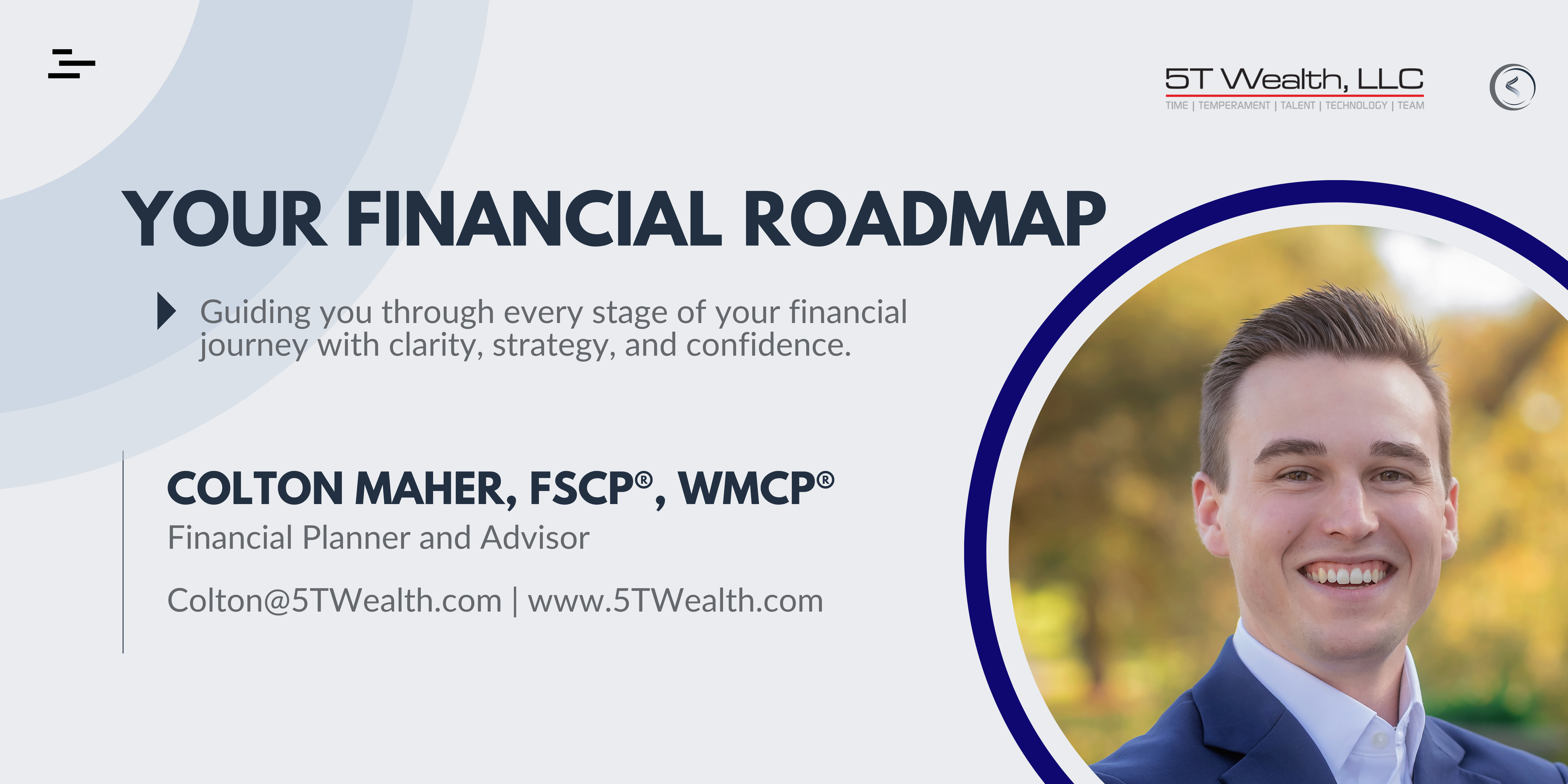
The Wealth Planning Disciplines
Only 36% of Americans have a formal financial plan, among those who do, 96% say they feel confident they will reach their financial goals1. A plan isn’t just a document, it is the difference between hoping and knowing. For this edition of Your Financial Roadmap, I'd like to bring you inside the mind of a financial planner, to share how we think about wealth planning at 5T Wealth and what it means to build a comprehensive wealth plan.
To us, wealth planning is a collection of interconnected disciplines. Each one deserves careful attention, and no decision should be made in isolation. A change in one area will almost certainly affect another. Which is precisely why coordination and context matter so much. Done well, these disciplines don't just coexist; they reinforce each other.
Here's how we break down a plan:
- Investment Management
- Retirement Planning
- Tax Planning
- Estate & Legacy
- Risk Management
- Goal Funding
- Business Planning (for business owners)
Investment Management
This is often the first thing that comes to mind when someone hears "wealth management" or "financial advisor” and for good reason. Investing is a central and critical part of what we do. After all, investing is how many build, expand, and preserve wealth. We spend a great deal of time studying public and private markets, monitoring world events, and analyzing economic trends to ensure your portfolio is positioned thoughtfully.
Paul and Chris explore investment management in greater depth in their respective newsletters, so I'll leave the more detailed analysis to them. What I will say is that we believe investment management is most powerful when it doesn't stand alone. It's most effective when it's informed by your tax situation, your goals, your timeline, and your overall plan.
Retirement Planning
At its core, retirement planning addresses two of the most fundamental questions in personal finance: When can I retire? and Will I ever run out of money? But it's worth stepping back and asking an even more personal question first: What does retirement actually look like for you?
For some, it's a clean break. A date on the calendar when work stops and the six Saturdays and a Sunday lifestyle begins. For others, retirement is more of a gradual transition. You might scale back to part-time work, shift your focus to a passion project, take on consulting work that keeps you engaged on your own terms, or simply wind down your responsibilities over a period of years rather than all at once. There is no single right answer, and a well thought out retirement plan should reflect your vision, not a generic template.
A strong retirement plan goes well beyond the timing question, though. It should outline a clear cash flow and distribution strategy, where your "retirement paycheck" will come from. That means thinking carefully about the sources of cash flow, which accounts to draw from, in what order, and when. It also means understanding how those withdrawals interact with taxes, Social Security timing, and Medicare costs. Considerations that can look quite different depending on whether you're fully retired or still earning some income along the way. These details can make a meaningful difference in how long your money lasts and the legacy you leave behind.
Tax Planning
While we are not CPAs and do not prepare tax returns, tax planning is one of the most impactful levers we have in helping clients build and preserve wealth. We help clients understand how their planning decisions affect taxes, both today and well into the future.
This might include evaluating the benefits of tax deferral versus paying taxes now at a known rate, identifying opportunities for tax-efficient investment strategies, or discussing potential deductions. We coordinate closely with your accounting partners to ensure that your wealth plan and your tax strategy are always working in the same direction, not against each other.
Estate & Legacy Planning
Similar to tax planning, we don't provide legal advice or draft legal documents — but we do play an active role in helping clients think through their estate and legacy goals, and we collaborate closely with your existing estate attorney or one of our trusted legal partners.
This could include conversations about simple wills and trusts or more complex topics like charitable giving, taxable estates, and planning for intergenerational wealth transfers. Going beyond the basic documents, the goal is to listen to your objectives and craft a careful plan that lives on for decades.
The cost of inaction can also be significant. Today, the federal tax rates for estates exceeding the exemption amount are 40%. That’s a large portion of your wealth going to the IRS instead of your intended beneficiaries. Here in California, estates that pass-through probate pay an estimated 4-8% in fees on the gross estate value. Both issues are substantial but also largely avoidable with the proper planning. These are the kinds of outcomes that careful, proactive coordination is designed to prevent.
Risk Management
Of all the foundational areas, risk management may be the most critical, especially in today’s environment. According to Simpson McCrady, so called ‘Nuclear Verdicts’ (Jury awards in excess of $10 million) are on the rise2. While investing, tax and estate planning are all aimed at growing or saving your wealth, risk management serves as the essential defensive barrier that preserves it.
At 5T, we believe we are the stewards of our client’s wealth, and that means we need to think through the risk exposure across your plan. It encompasses both the quantifiable aspects of asset protection, such as umbrella liability coverage and proper entity structuring, and the qualitative peace of mind that allows an investor to remain committed to their long-term goals during market volatility.
A comprehensive plan is only as strong as its ability to withstand the "what-ifs" of life: premature death, disability, long-term illness, catastrophic property loss, or lawsuits. Without a robust risk management strategy, even the most disciplined savings and investment regimens can be derailed in an instant by a single unforeseen event.
The primary mechanism for managing these low-probability but high-impact risks is the strategic use of insurance. By transferring the financial burden of these "ruinous risks" to an insurance carrier, we create the margin of safety necessary for long-term success.
Goal Funding
This is perhaps the most personal of all the disciplines and for that reason, the most varied. Every client has unique goals, and those goals often shift depending on their stage in life.
For some, it's funding a child's or grandchild's education. For others, purchasing a second home, building a meaningful travel budget, supporting a charitable cause, or even starting a private foundation. These goals aren't separate from your wealth plan; they are your wealth plan. Every aspiration connects back to the other disciplines, and keeping your goals at the center of the conversation is what gives all of this work its purpose.
Business Planning
An estimated 73% of privately held US companies are expected to transition ownership in the next decade, yet only half of all business owners have a formal succession plan in place3. For owners whose personal wealth is often deeply tied to the value of their company, personal and business finances are rarely separate conversations. Beyond net worth, your income, risk exposure, and long-term goals are deeply intertwined with the business you've built.
We analyze both sides of the equation for tax efficiency, entity structure, risk management, business succession, exit planning, and employee and executive benefits. Ensuring your business is supporting your broader goals rather than complicating them. Whether you're building toward an eventual exit or simply trying to bring more structure and efficiency to how you're compensated, this is an area where thoughtful planning can have an outsized impact.
The Bottom Line
The goal of this breakdown isn't to make wealth planning sound complex or overwhelming. It's to give you a window into the careful consideration and coordination that goes into a truly comprehensive wealth plan and to show you that no single decision is made in a vacuum.
At 5T Wealth, our focus is threefold:
- Listening with intent to your goals, your values, and your story.
- Collaborating with your other trusted advisors.
- Delivering world-class wealth management and client service.
That's how we build a plan designed to align your personal and financial resources; so, you can live the life you envision, with confidence.
If you know someone who might find this helpful, please pass it along. If this edition sparked some thoughts about your own financial roadmap, don't hesitate to reach out to us. We'd love to have that conversation.
All the best,
Colton Maher
Financial Planner and Advisor
5T Wealth, LLC
Main (707) 224-1340
Cell (707) 815-0843
Colton@5twealth.com
¹ Charles Schwab, "2024 Modern Wealth Survey." Conducted by Logica Research, March 4–18, 2024. National sample of 1,000 Americans aged 21–75. Available at: https://pressroom.aboutschwab.com/press-releases/press-release/2024/2024-Schwab-Modern-Wealth-Survey-Shows-Increasing-Financial-Confidence-From-Generation-to-Generation-and-Younger-Americans-Investing-at-an-Earlier-Age/default.aspx / 2 Simpson McCrady, "Protecting High-Net-Worth Assets in an Evolving Risk Landscape: 2025 Trends." Published June 19, 2025. Available at: https://simpsonmccrady.com/protecting-high-net-worth-assets-in-an-evolving-risk-landscape-2025-trends/ / 3 Exit Planning Institute, "2023 National State of Owner Readiness Report." Published 2023. Available at: https://exit-planning-institute.org/2023-national-state-of-owner-readiness
Disclosure and Disclaimer - Updated last on October 14, 2025:
CIO Insights is a proprietary newsletter written for clients, friends, and affiliates of 5T WEALTH, LLC (5T), which is an SEC registered investment advisor. Information presented is for educational purposes only. The information does not intend to make an offer or solicitation for the sale or purchase of any specific securities, investments, or investment strategies. Investments involve risk and are not guaranteed. 5T has reasonable belief that this letter does not include any false or material misleading statements or omissions of facts regarding services or investments. 5T has reasonable belief that the content as a whole will not cause an untrue or misleading implication regarding the adviser’s services, investments, or client experiences.
The opinions expressed are those of the author and are subject to change without notice. The opinions referenced are as of the date of publication and are subject to change due to changes in the market or economic conditions and may not necessarily come to pass. Any opinions, projections, or forward-looking statements expressed herein are solely those of the author. They may differ from the views or opinions expressed by other areas of 5T and are only for general informational purposes as of the date indicated.
5T has presented information in a fair and balanced manner. 5T is not giving tax, legal, or accounting advice.
Past performance should not be considered an indicator of potential future performance. If you do not consider yourself suitable, either emotionally or financially, to experience volatility and/or losses in financial markets, you should not invest. The portfolio managers at 5T do not guarantee investment results.
Charts, displays and graphs may be used as illustrations. They are not intended to be used by themselves to determine which securities to buy or sell, or when to buy or sell them. Such charts and graphs offer limited information and can’t be used on their own to make investment decisions.
CIO Insights does not represent the opinions of Fidelity, Fidelity Institutional Brokerage Group, NFS or anyone employed by Fidelity in any capacity. Neither Fidelity, Fidelity Institutional Brokerage Group, nor NFS, nor anyone employed by Fidelity in any capacity has participated in the creation of CIO Insights and they are not responsible for the contents or distribution of CIO Insights.
CIO Insights does not represent the opinions of Charles Schwab Corporation, Schwab Advisor Services or anyone employed by Schwab in any capacity. Neither Charles Schwab Corporation nor Schwab Advisor Services, nor anyone employed by Schwab in any capacity has participated in the creation of CIO Insights and they are not responsible for the contents or distribution of CIO Insights.
The investment objectives of various strategies mentioned in CIO Insights may be substantially different from one another. Therefore topics or investments mentioned in CIO Insights may or may not apply to specific managed accounts and/or strategies. If you are unsure which strategies your accounts are invested in please ask a representative of 5T to clarify that for you.
The assets held in managed accounts at 5T may include stocks, bonds, cash, commodities, foreign exchange, mutual funds or exchange traded funds (ETF's), money market accounts or limited partnerships that represent the same. They are subject to market fluctuation and the potential for losses. The assets are not insured. The value and income produced by these investment products may fluctuate, so that an investor may get back less than they initially invested.