

Will rising interest rates threaten the stock market?
As of last Thursday the S&P 500 had notched 24 new record highs in 2026. That’s after 39 new record highs in 2025, and 57 in 2024! It has been a wonderful bull run, and many pundits expect it to continue. Price targets keep being raised. Ed Yardeni is now calling for 8400 by the end of the year. He’s been spot on for years, so it’s hard to argue with him. AI is revolutionizing work, productivity, and learning. The bulls are running on Wall Street. Last week one commentator reported, “The momentum has been largely propelled by robust mega-cap technology and AI-related earnings, along side favorable inflation data that helped ease interest rate concerns.” If that last part is true, then why did I come across this story on Friday.
“On Thursday the U.S. government auctioned $25B in 30-year Treasury bonds (US30Y) at a yield of 5.216%, marking the highest rate for this tenor since 2001. This quarter-century high underscores investors' growing demand for increased compensation to finance the nation's expanding fiscal deficit.
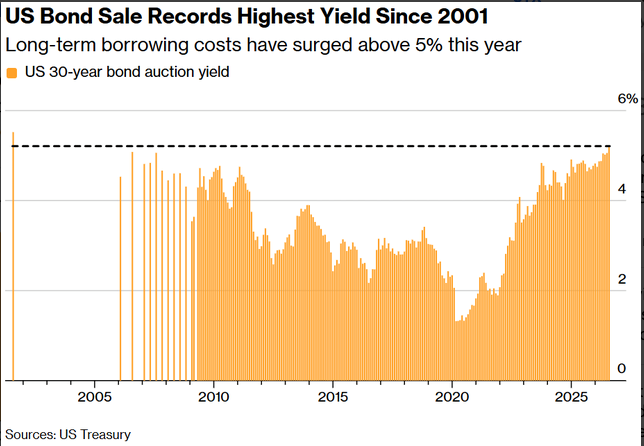
While the auction met with decent demand, there were clear signs of slight hesitation from buyers…. This comes a day after a 10-year Treasury (US10Y) auction that drew its highest financing costs since 2007. The broader surge in long-term yields is heavily driven by investor anxiety that rising energy prices, fueled by conflict in the Middle East, will sustain inflation and force the Federal Reserve to keep interest rates elevated.”
I’ve long been concerned that rising interest rates will eventually kill the stock bull market. I believe that long term rates will keep rising, which adds to my worries for longer term outcomes. Even so, stocks are not likely to suffer a significant setback in 2026. My base case for the rest of the year, which Chris Roth agrees with, is as follows:
1. The upward trend is our friend.
2. Wall Street clearly wants this market to continue upward.
3. The AI trade will continue to lead.
4. Pullbacks are buyable.
5. If one sector gets too far ahead, it will be sold, but money will rotate to other equity sectors.
If there is a significant correction it will likely be caused by other factors, rising oil prices, or some other unexpected shock. In the short term yields may continue to rise along with stock prices. Don’t be surprised if the 10-year Treasury yield pops above 5% before years end. Don’t be surprised if the S&P 500 hits Yardeni’s 8400 target. Last Friday I watched “talking heads” on CNBC scoffing at those of us who are worried about rising rates. I heard us referred to as “the boys who cry wolf”, and “wanting to sound smart”. I heard people declaring that “the national debt” is irrelevant. Wall Street and its cheerleader reporters are extremely confident that nothing will go wrong anytime soon. Their commitment to this bullish thesis is one of the reasons I believe stock prices will stay in their upward trend through the rest of the year. If the AI trade holds together, driving earnings for AI developers and users alike, the bull market could stay intact through 2027. But rising rates should eventually take their toll on stock prices, and my base case is that they will continue to rise.
Here’s why:
Our national debt as of 5:43 pm PDT, Sunday, August 16, 2026 is pictured below. It will exceed $40 trillion momentarily, and there is nothing the current administration is willing to do to slow the pace of its growth.
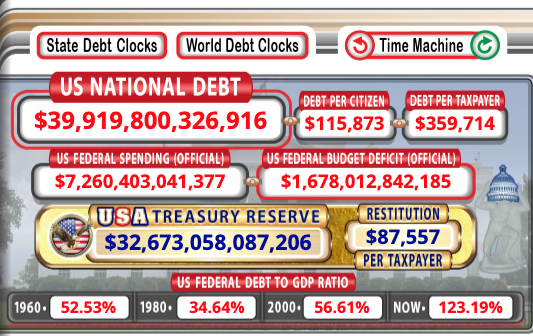
If you want to see how quickly its growing, go here https://www.usdebtclock.org/
The primary drivers of escalation include:
· Net Interest Outlays: With higher prevailing interest rates across the Treasury yield curve, annualized debt service costs have escalated to roughly $1.15 trillion, up from approximately $510 billion in 2020.
· Structural Deficits: Sustained primary deficits driven by mandatory outlays for Social Security, Medicare and defense spending continue to outpace federal revenue collection.
· Debt-to-GDP (Gross Domestic Product) Trajectory: Total gross federal debt now sits above 123% of GDP, continuing on an upward trajectory. (Source: Peter G. Peterson Foundation)
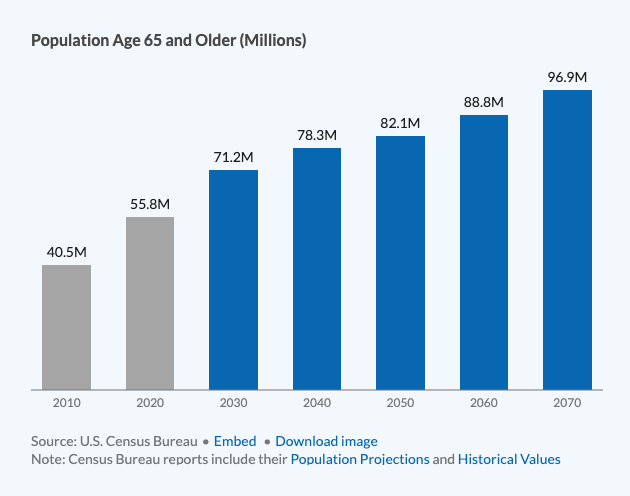
Social Security is identified as one of the primary reasons for the structural deficits. The USA is undergoing significant demographic change. Our society is aging as the large baby-boom generation retires — 10,000 people will turn 65 every day through 2030. Moreover, people are expected to live longer, on average. This is happening at a time when the Social Security primary retirement trust fund (Old-Age and Survivors Insurance, or OASI) is projected to exhaust its reserves in late 2032 or early 2033. When the reserve surplus reaches zero, Social Security will rely entirely on incoming payroll tax revenue, which is projected to cover only 78% to 80% of scheduled benefits under current law.
Will Congress let 20 to 22% of Social Security income disappear at a time when more people than ever need it. Will they decide to stop offering annual inflation adjustments and freeze benefits. Or, will they increase taxes to pay for restoring benefits. Will they just go on borrowing more, spending money they don’t have, and running up the national debt faster than ever? If you see a pleasant choice among these options please tell me.
Medicare is identified as the second reason for the structural deficit.
“In many ways, healthcare is the most important issue for our nation’s fiscal and economic future. It represents nearly one-fifth of our entire economy, and it is one of the fastest-growing parts of the budget. The U.S. healthcare system is the most expensive in the world, but we do not really get what we pay for. We spend nearly twice as much on healthcare as other advanced nations, but our system does not provide better overall health outcomes. Improving the performance of the U.S. healthcare system will not only improve Americans’ lives but also help stabilize our fiscal and economic outlook.” (Source: Peter G. Peterson Foundation)
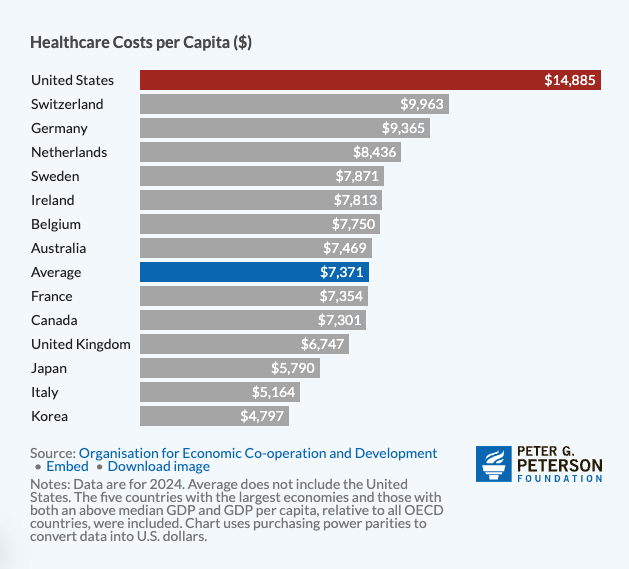
Historically medical care CPI (consumer price index) has grown at an annual rate roughly 1.5 to 2.0% faster than headline CPI. Although in the past couple of years that trend has reversed, according to official data. As Meghan and I watch health insurance costs continue to rise, and those of our team at 5T Wealth, I have trouble accepting “official data”. Ask yourself if you believe the rising cost of healthcare will moderate in the next 5 to 10 years?
Defense spending is identified as the third contributor to the structural deficit. Tell me if you believe our defense spending will decline in the next 10 years? But before you do, consider the answers to this question that I put to Google Gemini: “Since 1945 how many years has the U.S. military been in a shooting conflict, whether it’s a declared war or not?”
Answer: “All Kinetic Combat Operations: 70+ of the years since 1945. The only extended stretches with virtually no direct U.S. shooting engagements were brief windows in the late 1940s (1946–1949) and mid-to-late 1970s (1976–1979).” A kinetic combat operation refers to military actions that involve physical force and lethal energy to destroy, damage, or neutralize an enemy target.” The term comes from physics (kinetic energy—the energy of motion) and is used in military doctrine to distinguish traditional physical warfare from non-lethal, digital, or psychological operations. If including smaller-scale airstrikes, drone operations, special forces combat missions, and naval skirmishes, the U.S. has engaged in armed combat in nearly every single year since 1945.”
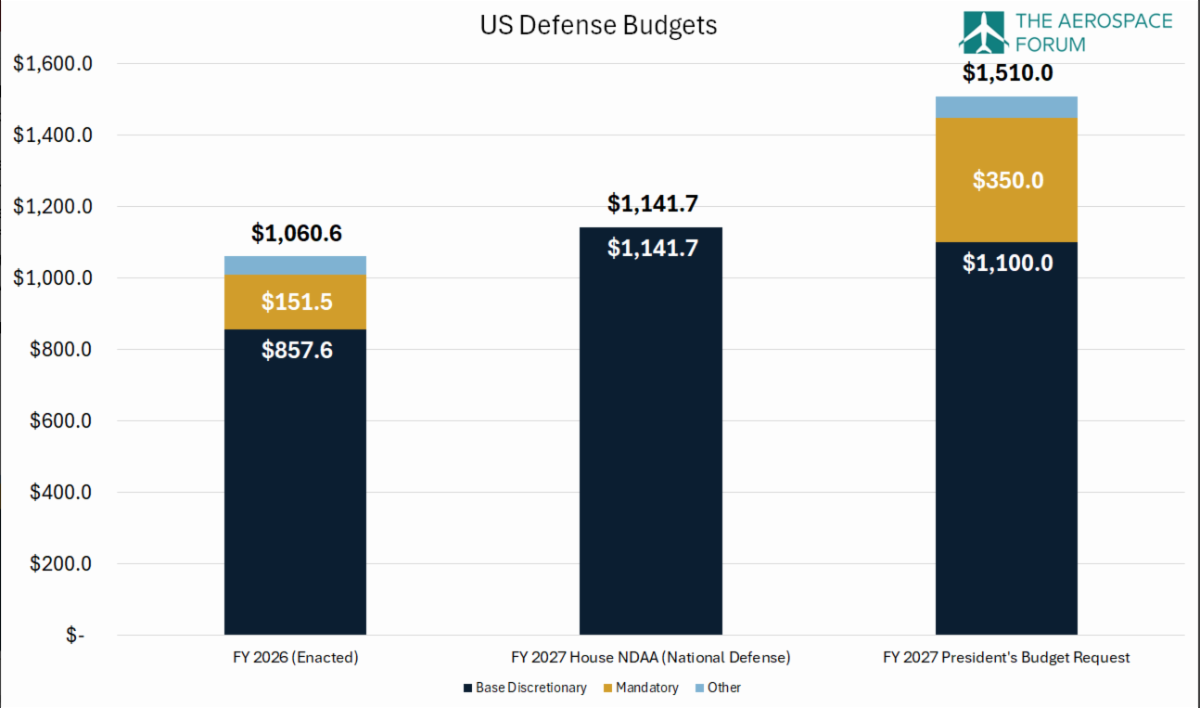
Further, consider that Secretary of War (it used to be called Secretary of Defense) Pete Hegseth is actively pushing for a massive expansion in U.S. military spending, asking Congress to approve an unprecedented $1.5 trillion defense budget for Fiscal Year 2027. This request represents an approximate 44% increase (an additional $454 billion) over previous topline levels, which would mark the largest defense budget surge since World War II. If approved by Congress, where is that $1.5 trillion going to come from? Probably deficit spending, adding to the national debt.
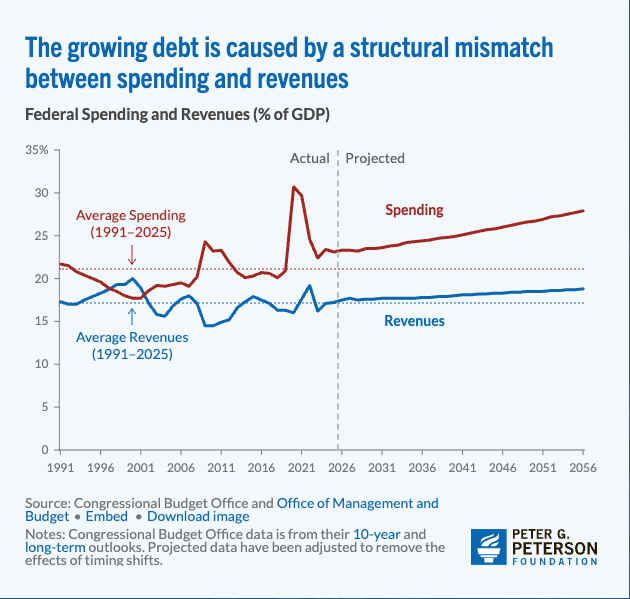
The final reason the debt keeps expanding is the structural mismatch between government spending and tax revenue. The U.S. tax system does not generate enough revenue to cover the spending policymakers have enacted. Democrats usually expand public investment and services without raising sufficient revenue. Republicans love to cut taxes without cutting public spending. It’s a bad combination!
The Geopolitical Economist reports, “Over the past year alone, the rate of increase in U.S. gross national debt has averaged $5.96 billion per day, $248.27 million per hour, $4.14 million per minute, nearly $69,000 per second. Consider what that means in human terms: in the time it takes a nurse to hang an IV bag in a hospital ward, the government of the United States has borrowed another $4 million…. The country is running out of fiscal room, not through some future catastrophe but through the compound arithmetic of a debt machine that is now self-accelerating. By the mid-2030s, interest payments could absorb nearly one-third of all federal revenue, and the time required to add another trillion dollars of debt is itself accelerating, from roughly 155 days currently to potentially less than 90 days by 2035…. The Congressional Budget Office projects that the One Big Beautiful Bill Act will add $3.4 trillion to deficits from 2025 to 2034, making it the most costly reconciliation act in recent history. Including additional interest costs raises the total price tag to $4.1 trillion. This is not an anomaly. It is the latest turn of the same crank that has been tightening since the Clinton surpluses evaporated in the early 2000s.”
For years we’ve been told not to worry by politicians. “We will grow out of it”, is one of their favorite sayings. “A rising GDP (gross domestic product) will shrink the debt-to-GDP ratio” is another. This is the “growth fairy” talking! The U.S. GDP was $228 billion in 1945. Today it is approximately $32.5 trillion. The debt-to-GDP ratio has never been higher! We have not grown out of it, and we won’t!
The USA is facing some extremely tough choices. We can keep borrowing money to pay for rising expenses and our national debt’s rate of increase is going to accelerate. We can raise taxes, balance the annual budget, and pay as we go. But, that will put a drag on the economy that everyone will feel. It could easily cause a serious recession as we adjust to that new reality. We can cut expenses, to match current tax revenues, and the rate of growth of the debt will decline. So will the standard of living of all the people counting on Social Security, Medicare, and other Federal benefits that will be cut. None of these options are without consequences. All of them should have been faced and dealt with years ago.
Imagine ignoring all your little health problems for the past 40 years of your life. (Unfortunately many people do) What do they become in the end? Large, difficult problems that are all but impossible to deal with, let alone solve! The fiscal health of the USA is no different. But politicians love to cast the debt crisis as a future crisis. Doing so is easy and implies it can be dealt with in the future. In the meantime, they buy votes by spending money they don’t have and making promises they can’t keep!
The Geopolitical Economist reports “On a recent episode of The Master Investor Podcast, JP Morgan Chase CEO Jamie Dimon was asked, would you buy long-dated government bonds at current levels? He replied, Personally, no. I would not be a buyer. Dimon has continually lobbied policymakers to take action on the debt, and they have continually ignored him. He is no longer surprised. Dimon forecasts rising yields as bond vigilantes require higher premiums to fund the nation’s debt.” He said, ‘My view is it will become a problem.’
I share the same view. It is going to become a problem. My best guestimate is that it will surface as a major, publicly debated problem, looking for resolution, either during or shortly after the 2028 election. The Democrats will likely try to make it a campaign issue for that election. The Republicans will likely try to put off the debate until after the election. I assure you that President Trump will prefer his successor takes it on. Going into whatever debates take place, neither party has clean hands on this issue. What frightens me the most is knowing that they must work together to solve it. Imagine that in today’s polarized political environment!
All the best,

Paul Krsek
CEO
5T Wealth, LLC
Main (707) 224-1340
Cell (707) 486-7333
Paul@5twealth.com

Disclosure and Disclaimer - Updated last on October 14, 2025:
CEO's Corner is a proprietary newsletter written for clients, friends, and affiliates of 5T WEALTH, LLC (5T), which is an SEC registered investment advisor. Information presented is for educational purposes only. The information does not intend to make an offer or solicitation for the sale or purchase of any specific securities, investments, or investment strategies. Investments involve risk and are not guaranteed. 5T has reasonable belief that this letter does not include any false or material misleading statements or omissions of facts regarding services or investments. 5T has reasonable belief that the content as a whole will not cause an untrue or misleading implication regarding the adviser’s services, investments, or client experiences.
The opinions expressed are those of the author and are subject to change without notice. The opinions referenced are as of the date of publication and are subject to change due to changes in the market or economic conditions and may not necessarily come to pass. Any opinions, projections, or forward-looking statements expressed herein are solely those of the author. They may differ from the views or opinions expressed by other areas of 5T and are only for general informational purposes as of the date indicated.
5T has presented information in a fair and balanced manner. 5T is not giving tax, legal, or accounting advice.
Past performance should not be considered an indicator of potential future performance. If you do not consider yourself suitable, either emotionally or financially, to experience volatility and/or losses in financial markets, you should not invest. The portfolio managers at 5T do not guarantee investment results.
Charts, displays and graphs may be used as illustrations. They are not intended to be used by themselves to determine which securities to buy or sell, or when to buy or sell them. Such charts and graphs offer limited information and can’t be used on their own to make investment decisions.
CEO Corner does not represent the opinions of Fidelity, Fidelity Institutional Brokerage Group, NFS or anyone employed by Fidelity in any capacity. Neither Fidelity, Fidelity Institutional Brokerage Group, nor NFS, nor anyone employed by Fidelity in any capacity has participated in the creation of CEO Corner and they are not responsible for the contents or distribution of CEO Corner.
CEO Corner does not represent the opinions of Charles Schwab Corporation, Schwab Advisor Services or anyone employed by Schwab in any capacity. Neither Charles Schwab Corporation nor Schwab Advisor Services, nor anyone employed by Schwab in any capacity has participated in the creation of CEO Corner and they are not responsible for the contents or distribution of CEO Corner.
The investment objectives of various strategies mentioned in CEO Corner may be substantially different from one another. Therefore topics or investments mentioned in CEO Corner may or may not apply to specific managed accounts and/or strategies. If you are unsure which strategies your accounts are invested in please ask a representative of 5T to clarify that for you.
The assets held in managed accounts at 5T may include stocks, bonds, cash, commodities, foreign exchange, mutual funds or exchange traded funds (ETF's), money market accounts or limited partnerships that represent the same. They are subject to market fluctuation and the potential for losses. The assets are not insured. The value and income produced by these investment products may fluctuate, so that an investor may get back less than they initially invested.